 Paper
Paper
 Code
Code
 Dataset
 01
01
Expert
Goal-directedRRT* planning with PD tracking, wider safety margins, and low control noise.
Latent world models · On-orbit autonomy
1University of Chinese Academy of Sciences 2Key Laboratory of Target Cognition and Application Technology (TCAT), Aerospace Information Research Institute, Chinese Academy of Sciences
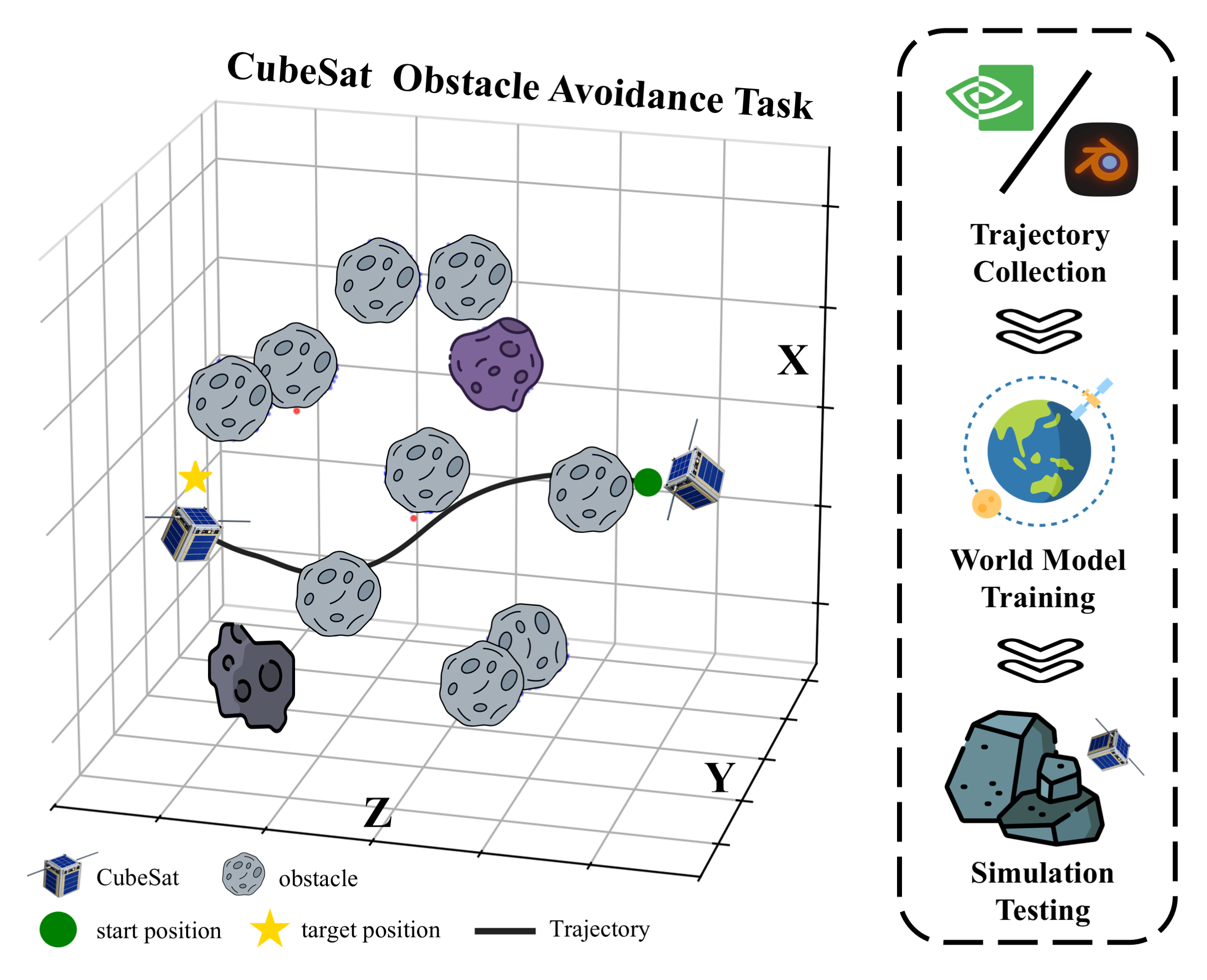
A CubeSat agent that imagines action-conditioned futures in latent space, recovers physical state changes, and plans collision-free maneuvers online.
01 / Demo
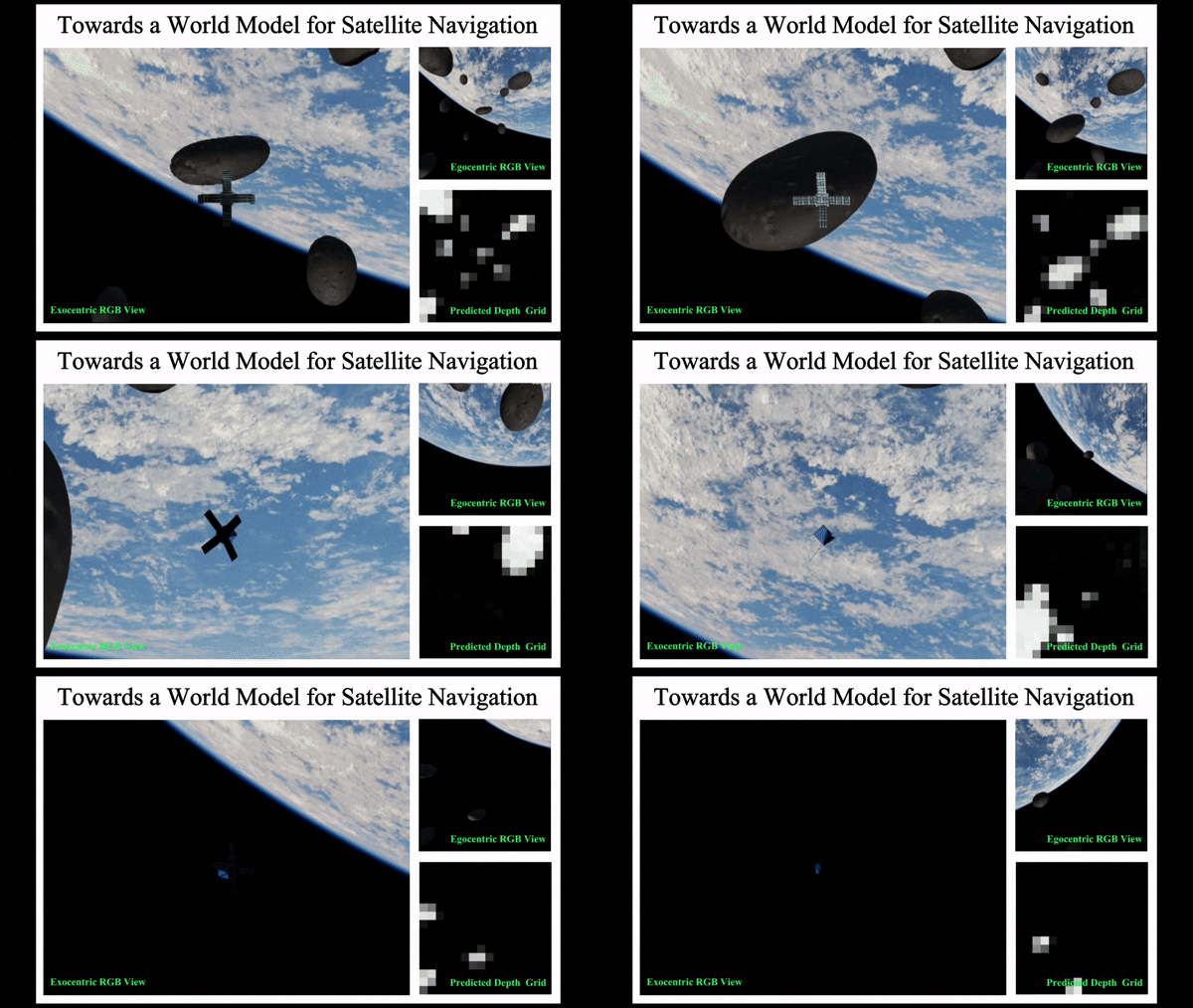
Orbit-Planner continuously predicts future latent states, decodes physical states, and replans before executing the next control action.
02 / Dataset
8,000 trajectories are collected with randomized obstacles and lighting: 7,200 for training and 800 for testing. Three behavioral modes expose the model to safe, unsafe, and exploratory motion.
01
RRT* planning with PD tracking, wider safety margins, and low control noise.
 02
02
Direct goal-seeking trajectories without obstacle-aware planning.
 03
03
Strong random action noise for broad, unstructured state-space exploration.
03 / Framework
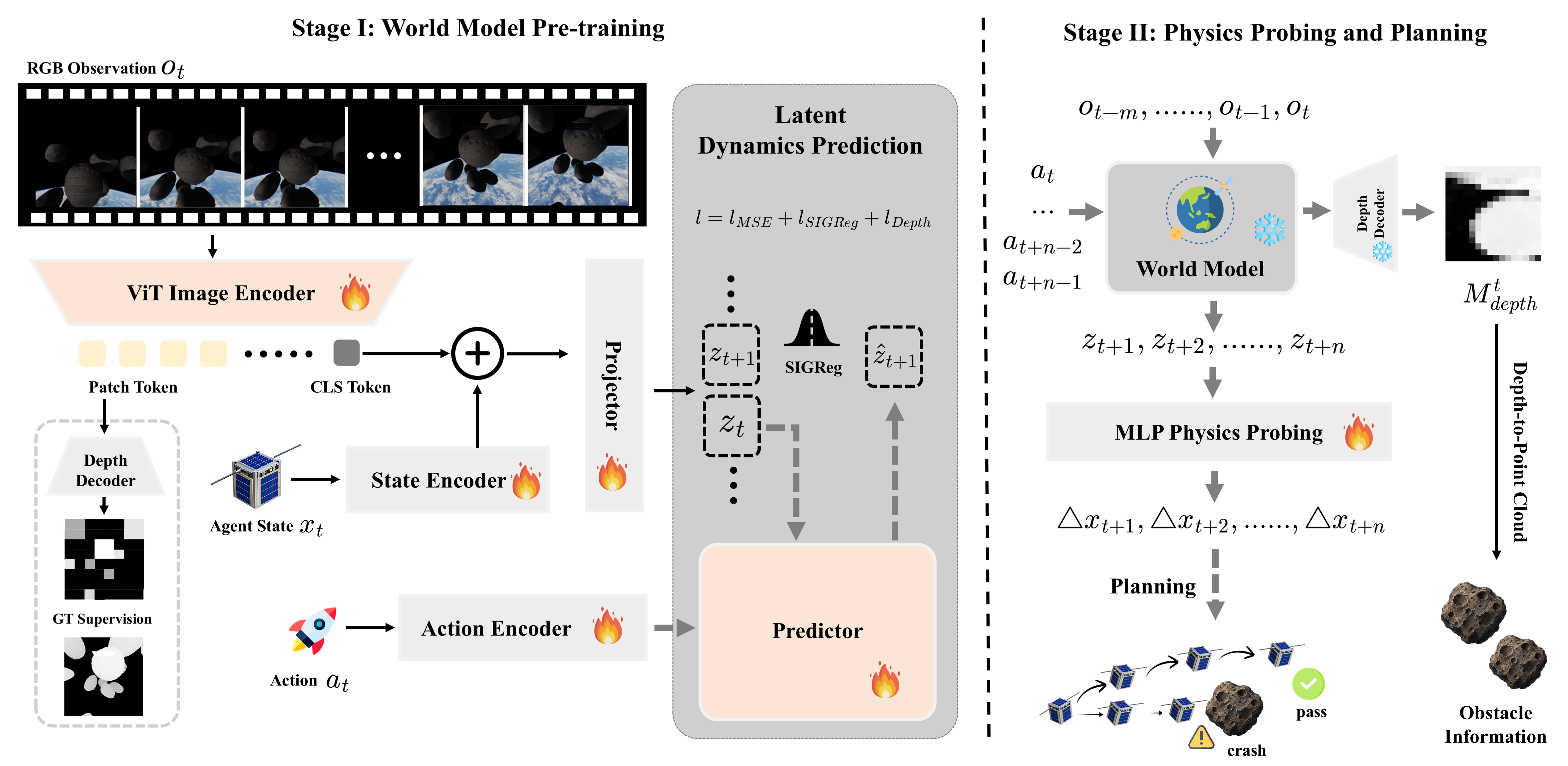
Stage I learns a multimodal predictive representation from RGB, spacecraft state, and control actions. Stage II freezes the world model, probes imagined physical changes, and plans with recovered obstacle geometry.
04 / Results
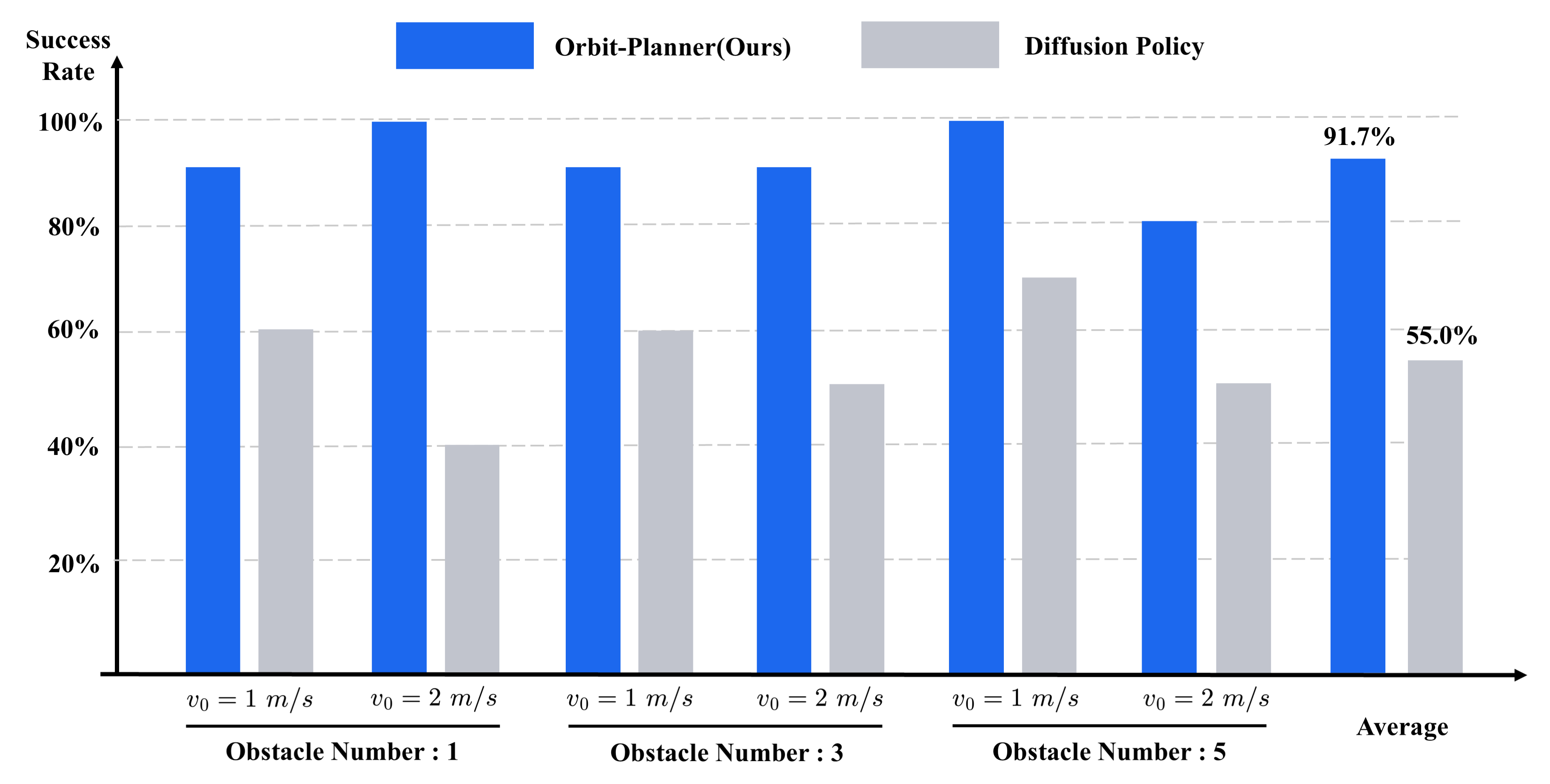
Across six unseen settings with one, three, or five obstacles and two initial velocities, Orbit-Planner consistently outperforms the reactive imitation-learning baseline.
@article{li2026orbitplanner,
  title   = {Orbit-Planner: Towards Latent World Models for On-Orbit Obstacle Avoidance of Satellite Agents},
  author  = {Li, Zhijian and Ren, Chao and Wang, Peijin and Sun, Xian},
  journal = {arXiv preprint arXiv:2608.16651},
  year    = {2026}
}